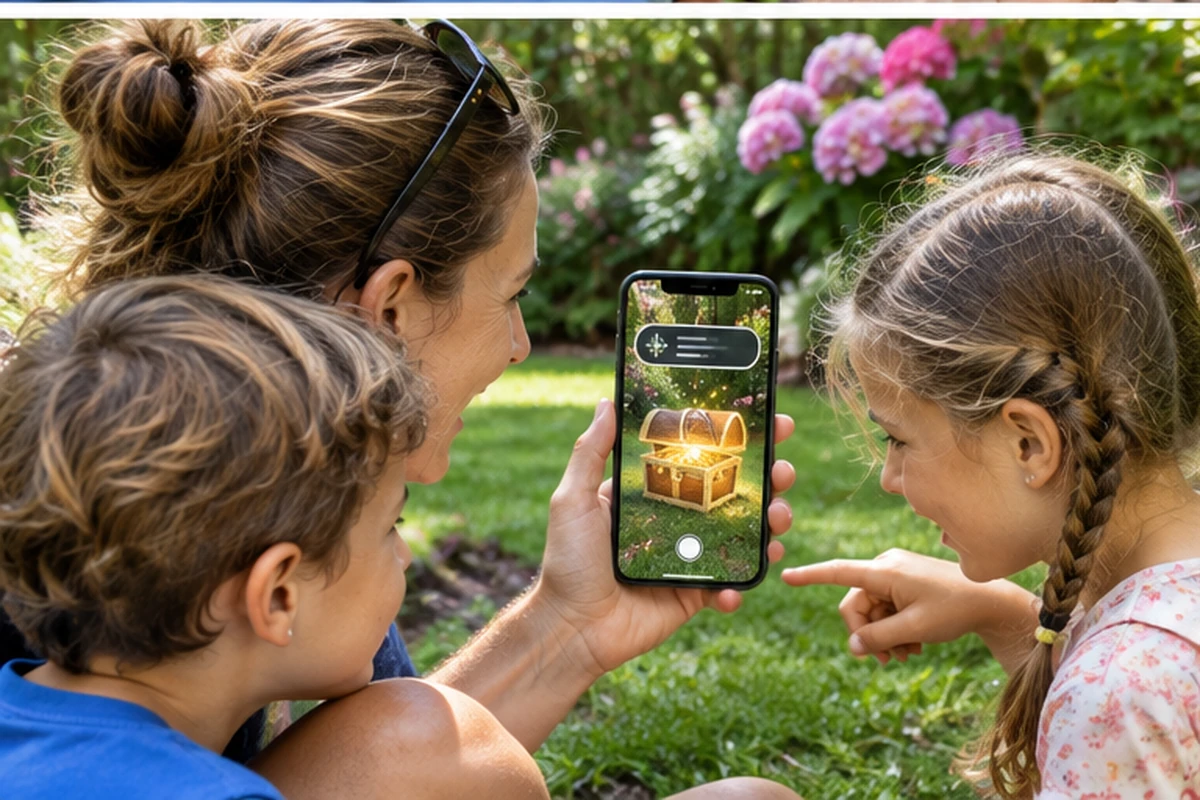
Take your treasure hunt onto your phone
Try IGC Loyalty for free to follow clues, discover digital treasures using your phone camera and explore rewards as you go.
Choose a route you can test, make the digital clue at each stop easy to understand, and invite people to download IGC Loyalty for Android or iOS when the hunt is ready.
IGC Loyalty lets organisers create location-based checkpoints and clues that participants see on their phones. Players can use the AR camera to discover virtual treasures at the selected places. The idea is still a good outdoor game first, with the phone adding an interactive layer.
Move from paper ideas to AR treasures
For smaller children, simplify the route and involve an adult at every stop. Participants can enjoy the same locations at different difficulty levels without the organiser needing to build an entirely separate hunt.
A scavenger hunt for 11 year olds benefits from a little independence. Give each team a choice between two clues leading to the same checkpoint, include one code-word puzzle and ask players to justify how they found the answer. Finish with a team challenge, such as remembering the order of the landmarks they visited.
Make the clues harder for older children
An easter outdoor scavenger hunt might end with a small family surprise at a picnic table. Along the way, use clues about colours, nesting birds and springtime shapes. A slightly different outdoor easter scavenger hunt can be run as a team race, provided the route stays safe and nobody needs to search through flower beds.
A spring outdoor scavenger hunt can celebrate the changing season: look for new leaves, listen for birdsong and notice flowers beginning to bloom. Ask teams to describe what looks different from their last visit, then discuss their answers together at the finish.
Make it seasonal without complicating the route
For a larger park, divide players into small teams and agree on a meeting point. The goal can be to notice five different textures, compare three leaf shapes or photograph an interesting view. Encourage observation rather than collecting natural objects.
A state park scavenger hunt can focus on things visitors are already allowed to observe: an information sign, a distinctive tree, a scenic viewpoint and evidence of local wildlife. Check the park rules and avoid posting materials to trees or leaving anything behind. Use phone clues when you want the activity to stay entirely digital.
Bring the hunt to a public park
To make a treasure hunt game outdoor work smoothly, avoid routes that cross roads, private property or areas where children could lose sight of the group. Test the timing: four checkpoints may take fifteen minutes for older children but considerably longer for toddlers.
You can organise a free outdoor scavenger hunt with a short list of observations, a clear finish point and no special equipment. If your group uses IGC Loyalty, the organiser can set up digital checkpoints and show clues on players' phones. Virtual treasures appear through the phone camera, giving participants a reason to move from one location to the next.
How to run a free outdoor scavenger hunt
In a garden treasure hunt, mix two easy clues with one that takes more thought. Encourage players to explain how they solved each riddle. Younger children can work with a parent or sibling while older children take turns reading the next prompt.
- “I hold water for thirsty flowers, but I am not a cloud.” Look for a watering can.
- “I stay in one place while people rest on me.” Find a bench.
- “My roots are hidden and my branches reach the sky.” Find a tree.
- “I am made for walking, but I never move.” Look for a garden path.
- “I have petals, but no pages.” Find a flower that is visible from the path.
Five ready-to-use garden clues
For a backyard treasure hunt, try hiding the answer in ordinary details instead of hiding objects: a bench with a view, a bright planter, the tallest tree or a place where rainwater gathers. This lets children solve clues without turning the garden upside down.
The best outdoor hunt does not need a huge space. A small backyard, shared garden or nearby park can provide enough landmarks for a beginning, a middle and a satisfying finish. Choose a safe starting place, four to six points of interest and one spot where everyone can gather at the end. Set boundaries before the game begins.
Start with a route that feels like a game
Related activities
Take your treasure hunt onto your phone
Try IGC Loyalty for free to follow clues, discover digital treasures using your phone camera and explore rewards as you go.